Beach Buggy Racing
- 4.5
- Rating
- 100.00M
- Installs
- Free
- Price
 Analysis by App-foxy
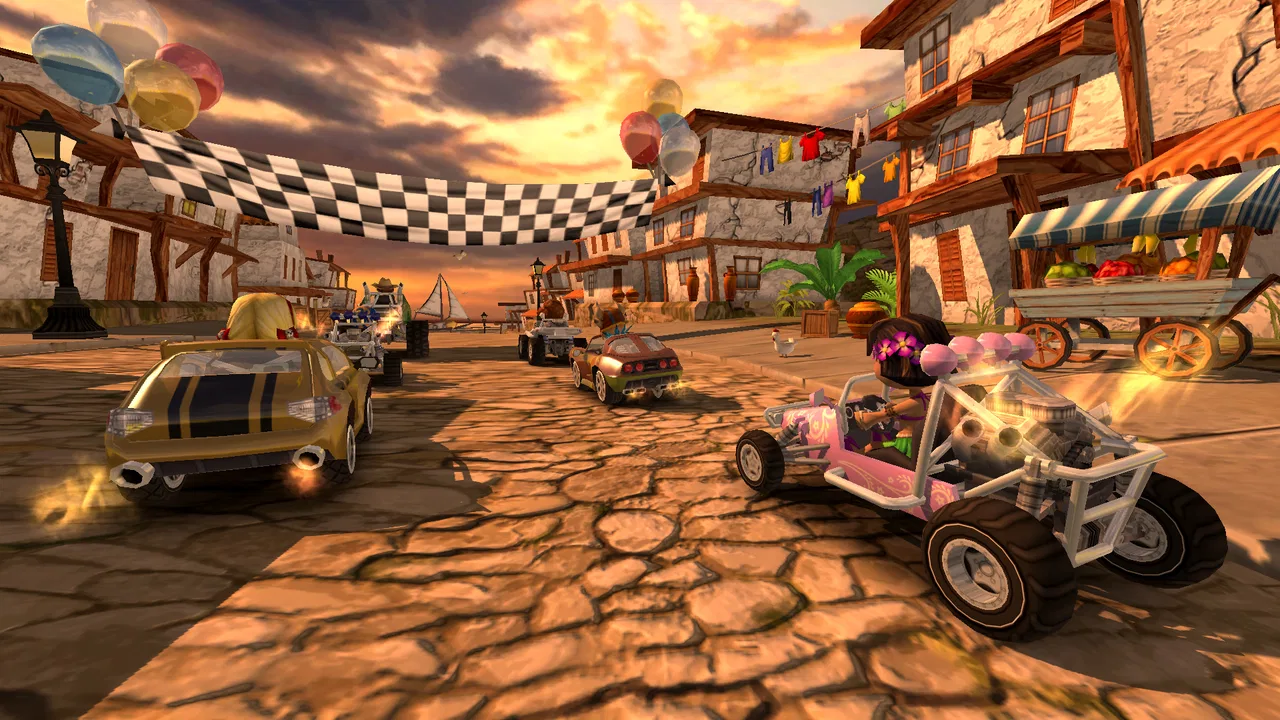
Beach Buggy Racing is the kind of mobile racing game I can open for a few minutes and still feel that I have made progress. It is a colorful 3D kart racer from Vector Unit, built around quick races, collectible power-ups, vehicle upgrades, and the simple satisfaction of finishing ahead of the pack. I found it easy to understand immediately, but there is enough room for better driving habits to matter once the early races stop being effortless.
The game is free to download and aimed at Everyone, which makes it an approachable choice for family play or for someone who does not normally spend time with racing games. Its strong reception is also easy to understand: it holds a 4.5 average from around 3 million ratings and has passed 100 million installs. Those figures do not replace personal experience, but they reflect how broadly this particular style of kart racing has connected with mobile players.
How I settled into the race-by-race workflow
My normal session starts with a quick look at the available race, followed by a decision about whether I want to chase a win, collect progress, or improve a vehicle. That distinction matters because the game is more enjoyable when I stop treating every event as something that must be conquered immediately. Some races reward a cautious run with clean positioning, while others become much easier when I accept a little chaos and use the power-ups aggressively.
You May Also Like

 Blood Strike: 2.5 Anniversary
Blood Strike’s Loadouts Turn Every Drop Into a Tactical Gamble
A close look at Blood Strike’s custom loadouts: how fast access to signature weapons reshapes its battle royale rhythm, rewards preparation, and narrows the gap between fights.

 Pandora - Music & Podcasts
Pandora’s Music Is Easy to Start, but Harder to Recover
Pandora’s strength is its low-effort path from a seed to a station. Its weak spot is how much confidence it asks you to place in connection, setup, and quiet recovery.

 8 Ball Pool
 Is Built on Rivalries, Rematches, and Routine
A close look at the rivalries, rematches, shared routines, and unanswered safety questions that turn a quick pool match into a persistent mobile community.

 Samsung Music
’s Quiet Strength Is Playing What You Already Own
Its reach comes less from spectacle than from dependable access to a personal library. That simplicity is both the app’s strongest retention engine and its ceiling.

 AccuWeather: Weather Radar
AccuWeather Review: A Quick, Clear Forecast for Everyday Decisions
For everyday plans, the best forecast is the one you can understand quickly. AccuWeather makes rain timing, radar, and local conditions easy to act on, with a few trade-offs.

 Hill Climb Racing
Why Hill Climb Racing Still Turns Crashes Into One More Run
A tiny car, a bumpy hill and one more upgrade: Hill Climb Racing keeps resurfacing because its simple chaos makes every near-miss feel personal.
More From Our News Desk
View All News


The basic loop is familiar: choose a vehicle, drive through a compact course, collect useful items, and invest rewards into improvements. What makes the routine work is the short distance between an attempt and the next decision. I never feel trapped in a long campaign segment after a poor race. I can try again, change my approach, or spend a little time improving the vehicle before returning to the track.
For an everyday example, I would use it during a commute break or while waiting for an appointment. I can complete a race without needing a long uninterrupted evening, yet the session still has a clear purpose. If I lose, I usually know whether I was too slow through corners, used an item too early, or allowed another racer to push me away from the ideal line. That sense of immediate feedback is one of its best qualities.
The controls are designed for touchscreens rather than pretending that a phone is a console. I found the steering responsive enough for quick corrections, although the best option depends on how I hold the device. Tilt-style control can feel natural for players who like moving the whole phone, while touch controls are easier for me when I am playing in a crowded place or trying to keep the screen steady. I recommend testing the available control choices before judging the handling.
My first useful habit was to stop steering constantly. Small, deliberate corrections are more reliable than sweeping from side to side, especially when the track narrows or a power-up creates confusion. Holding a line through a bend also leaves more attention for watching the road ahead. The game looks playful, but careless steering can waste more time than a badly chosen item.
Power-ups add the arcade layer that separates this from a straightforward time-trial racer. I try not to fire the first useful item the moment I receive it. A defensive item has more value when another racer is close enough to threaten my position, while an offensive item is often better saved for a straight section where the target is easier to read. This is a small change, but it makes races feel less dependent on luck.
The upgrade loop is equally important. I prefer improving the vehicle that already suits my driving rather than spreading resources across everything available. A vehicle that turns predictably may help me more than one that appears faster but is harder to control. That is a practical trade-off: raw performance is not useful if I keep losing speed by hitting barriers or overcorrecting in corners.
Settings I would check before serious racing
I would not begin by changing every option. I would first make sure the control method feels comfortable, then adjust the presentation so that the track remains readable on my phone. Bright effects and fast-moving scenery can be entertaining, but clarity matters more when I am trying to spot a bend, a ramp, or an item pickup. A stable, readable screen helps more than making the game look as busy as possible.
Sound is worth considering as well. I like having enough audio feedback to notice collisions and item activity, but I do not always want engine noise competing with everything else around me. When I play in public, lowering the volume or using headphones makes the experience less distracting. This is not a performance trick, but it changes how carefully I can react to what is happening on the track.
Players should also check the device requirements before installing. The game supports devices running Android 7.0 or later, so an older phone may not be a suitable fit even if it can install other lightweight racing titles. On a compatible device, I still prefer closing unnecessary background activity before a longer session. That is a sensible preparation step for any 3D game and helps me avoid blaming the controls for a phone that is already struggling.
The current version is 2025.09.22, which is useful to know when comparing what appears on your screen with older videos or advice. Mobile games can change their menus, balance, or presentation over time, so I treat old tutorials as general guidance rather than exact instructions. The main driving principles remain useful, but a player should rely on the current in-game layout when planning upgrades or races.
Because the game is free, I can try it without committing money at the start. It does include optional purchases priced from $1.99 to $19.99 per item. I recommend deciding in advance whether I am willing to spend anything, because upgrade-focused games can make a small purchase feel tempting after a frustrating loss. I had a better experience when I treated purchases as optional rather than as a shortcut I needed to keep up.
Driving patterns that make repeat attempts faster
The biggest improvement came from learning to prepare for corners before reaching them. I try to finish a power-up decision and settle the vehicle before the turn begins. Entering a bend while still changing direction, aiming an item, and watching another racer usually creates unnecessary mistakes. A calmer approach lets me preserve speed and gives me a better chance of exiting in a useful position.
I also look farther ahead than the next few metres. The track often gives enough visual information to suggest what is coming, so I use the current straight section to plan the next bend rather than reacting at the last moment. This is particularly useful when several racers are close together. If I know where I want to place the vehicle, I am less likely to be pushed into an obstacle by the pack.
Shortcuts and alternate routes deserve a careful approach. I do not assume that the most dramatic-looking path is automatically faster. A route that includes a jump or a narrow opening may save time when I approach it cleanly, but it can cost more if I hit a wall or land badly. My repeatable method is to test a route during a low-pressure attempt, remember where the entry begins, and only use it in a competitive race once I can take it without improvising.
This is where experienced play separates itself from random button pressing. I watch for places where the track gives me a choice between safety and speed. If I am already leading, the safer line is often the correct one. If I am behind near the finish, the riskier route may be justified. The useful question is not “Which path looks fastest?” but “How consistently can I take this path with my current vehicle and control setup?”
Power-up timing follows the same principle. I keep a defensive option when the group is tightly packed and avoid wasting an attack on a distant target. If I am approaching a narrow bend, I may wait until the road opens instead of triggering an item while steering. That delay can feel conservative, but it prevents the common situation where the item animation distracts me just long enough to miss the corner.
When I replay a race, I change one thing at a time. I might use a different line through the first difficult turn, hold an item for longer, or choose a different upgrade. Changing everything at once makes it impossible to know what helped. This simple testing habit turns losing into useful information and keeps the game from becoming a cycle of repeating the same mistake.
Another practical pattern is matching the vehicle to the track rather than always choosing a favorite. A vehicle that feels excellent on open sections may be awkward on a course that demands frequent turning. Conversely, a more manageable vehicle can produce a better result even if its top potential seems less exciting. I value consistency because a clean race usually beats a theoretically faster setup that I cannot control.
Where the arcade design reaches its limits
The same features that make the game accessible can limit it for serious racing fans. The power-ups introduce unpredictability, so a perfect driving line does not always guarantee a win. I enjoy that uncertainty in short sessions, but players looking for a pure test of braking points and lap precision may prefer a dedicated simulation or time-trial racer. This is an arcade kart game first, not a substitute for a realistic motorsport experience.
Progress can also encourage repetition. Replaying races is useful when I am learning a route or building resources, but it can become routine if I want constant new events. The upgrade system gives those repeats a reason, yet it does not remove the feeling that I am revisiting familiar content. I would skip this game if I need a racing campaign that continually changes its structure and offers deep vehicle tuning at every step.
The free-to-play format is another consideration. Optional purchases are clearly relevant to the overall design, even though I can begin without paying. A player who dislikes upgrade pressure or prefers a single upfront purchase may find the model less comfortable than a premium racing game. For children, I would use the device’s purchase safeguards and explain that spending is not required to enjoy the basic races.
It is also not the best choice for every playing environment. Touch racing needs attention, and tilt controls can be awkward when I am standing or sharing a small space. The bright presentation is part of its charm, but players who want a quiet, minimal interface may find it visually loud. In those situations, a simpler top-down racer or a more restrained time-trial game could be a better match.
Compared with endless runners that include driving sections, this offers more deliberate racing decisions. I have more reason to think about lines, items, and upgrades instead of simply surviving until the next obstacle. Compared with realistic racers, it is much easier to pick up and forgiving of casual play. Its closest strength is that middle ground: enough structure to reward practice, but not so much complexity that I need a wheel, a long tutorial, or a large block of free time.
One limitation I noticed in my own use is that progress feels most satisfying when I actively set a goal. Without a target, I can drift into repeating races just because they are available. I get more from the game when I decide to improve one vehicle, learn one shortcut, or win a particular event. That approach keeps the upgrade loop focused and prevents the session from feeling like empty grinding.
Who will get the most from it
I would recommend it to players who want a colorful kart racing game that works in short bursts and still rewards better habits. It suits families, casual mobile gamers, and anyone who likes the combination of driving, collectible items, and gradual vehicle improvement. The Everyone rating supports its broad accessibility, although younger players may still need guidance around optional purchases and screen time.
It is especially good for someone moving from simple arcade racers toward something with more decisions. I can start by steering and using items instinctively, then gradually learn route choices, timing, and vehicle selection. That layered learning curve is more valuable than the store summary suggests because it gives the game a second life after the novelty of colorful tracks wears off.
I would steer competitive simulation fans elsewhere. If your priority is realistic physics, detailed tuning, or a clean leaderboard-focused experience, this game’s power-ups and playful handling may feel too unpredictable. I would also avoid it if you strongly dislike free-to-play progression, even when purchases are optional. The right audience is someone who sees racing as quick, energetic entertainment rather than a strict driving test.
My verdict after learning its rhythm
Vector Unit has made a racing game that is easy to enter but not completely shallow. My best sessions came after I stopped relying on frantic steering and began treating each race as a small experiment: choose a suitable vehicle, check the control setup, learn the important turns, and save power-ups for moments where they have a clear purpose.
The most useful habit is consistency before speed. A dependable line, sensible item timing, and a vehicle I can control will usually help me more than chasing an impressive shortcut before I am ready for it. That advice applies specifically to the way this game combines compact tracks, arcade hazards, and upgrade choices.
Released on September 16, 2014, it has remained recognizable because its central loop still works on modern mobile devices. The current version keeps it relevant for players discovering it now, while the free entry point makes trying it straightforward. I would not call it flawless, but its limitations are clear enough to judge fairly.
My final recommendation is positive for casual and intermediate racers who want quick 3D kart action with room to improve. I would download it for short breaks, family-friendly competition, or a relaxed upgrade project. I would skip it only if I wanted simulation depth, a purchase-free structure, or racing that depends entirely on precision rather than power-ups and playful unpredictability.
FAQs for Beach Buggy Racing
01What devices are compatible with Beach Buggy Racing?
Beach Buggy Racing is available on both Android and iOS platforms. It requires iOS 8.0 or later, making it compatible with iPhone, iPad, and iPod touch. For Android users, it typically requires Android version 4.0.3 and up. Ensure your device meets these requirements for optimal gameplay.
02Is Beach Buggy Racing free to play?
Yes, Beach Buggy Racing is free to download and play. However, it does offer in-app purchases for various items and upgrades. These purchases can enhance gameplay, but they are optional. Players can disable in-app purchases in their device settings if they wish to avoid them.
03What gameplay features does Beach Buggy Racing offer?
Beach Buggy Racing features exciting gameplay with a variety of racing tracks, power-ups, and customizable vehicles. Players can enjoy single-player modes or compete in multiplayer races. The game also offers unique drivers, each with special abilities, adding strategic depth to the racing experience.
04How can I play Beach Buggy Racing with friends?
To play Beach Buggy Racing with friends, you can use the multiplayer mode. The game supports split-screen local multiplayer on devices with larger screens. Alternatively, you can compete online by connecting through social media platforms or using the game’s online multiplayer features.
05What are the system requirements for smooth gameplay?
For the best experience, ensure your device meets the minimum system requirements: iOS 8.0 or later for Apple devices and Android 4.0.3 or later for Android users. A device with a higher RAM and a good graphics processor will enhance performance, reducing lag and improving graphics quality.
Pros
- Vibrant graphics enhance gameplay experience.
- Diverse tracks keep racing exciting.
- Multiple power-ups add strategic depth.
- Smooth controls for easy navigation.
- Multiplayer mode for competitive fun.
Cons
- In-app purchases can be costly.
- Limited customization for vehicles.
- Ads can interrupt gameplay.
- Some tracks feel repetitive.
- Occasional lag on older devices.

Beach Buggy Racing
Gallery